
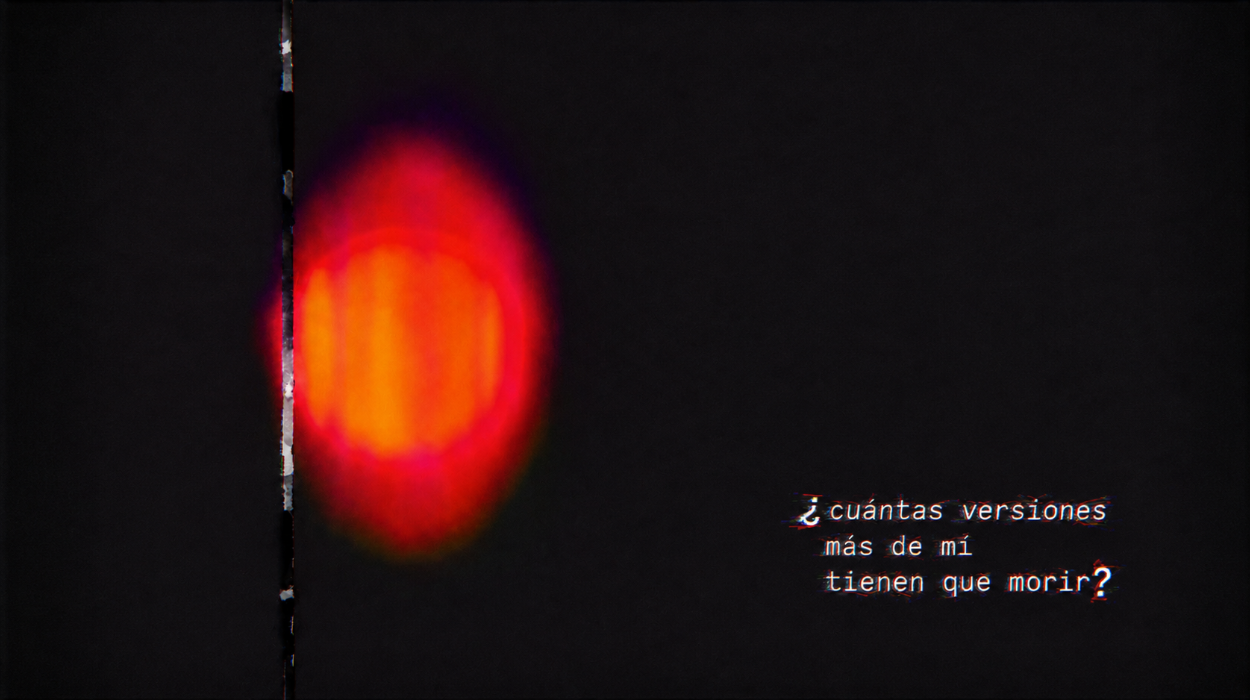
The failure of what once promised a radiant, modern future in Latin America is the axis of Fátima Rodrigo’s work. In this visual inquiry, shine—produced through materials that emit light—emerges as a code associated with spectacle, consumption, and certain forms of excess that modern culture has dismissed as sentimental or in poor taste. Her practice gives material form to what I will call “residual modernism.” That is, the cold, rational, supposedly universal geometry of modernism is reappropriated, absorbed and displaced into forms that the modernist project itself would likely never have recognized as its own. This modern geometric language thus reappears as the backdrop to a series of phenomena within Latin American popular culture where sexist spaces and discourses have repeatedly found a home. Within this inquiry, as a modernizing apparatus, television recurs throughout Rodrigo’s work.
Following its arrival in Mexico in the mid-1950s and its rapid incorporation into domestic life (studies state that, within just two decades, nearly every household owned one), television enabled the circulation of national and international messages from a world undergoing rapid transformation. Through its programming, it generated new discourses that would shape behavior and influence ideas about everyday life. The ways in which this apparatus—in Foucauldian terms, a dispositif—participates in the production, regulation, and circulation of gendered discourses has been a sustained concern in the artist’s practice. Earlier series testify to this interest by examining the influence of the small screen on the sentimental education not only of Mexico, but also of countries such as her native Peru.
Within those works, musical television stages take on a central place. Whether in drawing, intervention, or sculpture-driven installations, Rodrigo recreates these ephemeral architectural sets from variety shows using images salvaged from YouTube clips. Amid brightly colored diamonds, pastel-toned props, and tungsten spotlight lighting effects—visual motifs whose unmistakably kitschy character could be read as subtly departing from the gender mandates of their time—singers such as José José performed songs laden with narratives that reaffirmed traditional gender roles, including submission and violence.
Meanwhile, the exhibition—whose title translates as “How many more versions of me must die?”—turns to Televisa as a producer of narratives about what it means to be a woman in Latin America. Although not exclusively, telenovelas (soap operas) have been a major vehicle through which Televisa has constructed what Italian theorist Teresa de Lauretis termed technologies of gender: cultural devices and practices that produce and naturalize particular forms of femininity and masculinity through representation. Historian Melixa Abad-Izquierdo describes the telenovela as a melodrama built around a basic narrative mechanism: “a poor young woman falls in love with a wealthy young man; the protagonist faces obstacles with resignation, almost heroically; the central conflict is the struggle between good and evil” portrayed without nuance, in starkly Manichean terms. A paradigmatic example is the 1987 teen telenovela Quinceañera, which follows two teenage friends—one working class, the other from an affluent family—as they transition from girlhood into womanhood.
Amid storylines involving class inequality, sexual violence, juvenile delinquency, drug use, and unwanted adolescent pregnancy, Quinceañera ultimately centers its greatest conflict on the hardships Maricruz—the impoverished friend—endures in trying to afford her fifteenth birthday celebration, the rite of passage during which, as the telenovela’s famous theme song puts it, marks the moment when “little by little, the girl dies.”
Across Latin America, telenovelas have long been regarded as “cheap” entertainment for feminized audiences, and their defining feature—as with melodramatic sensibility more broadly—is excess. Rodrigo condenses this excess into the cake from Quinceañera, transforming it into sculpture. The result is a three-tiered structure supported by silver columns, each level coated in textured paint shaped into yellow flowers and pink ribbons. Crowning the third tier of this saccharine monument is a doll dressed in a voluminous pink gown with cascading ruffles, a reiteration of the quinceañera figure. It is no coincidence that this kind of excess—simultaneously ornamental and sentimental—has historically been associated with femininity and therefore relegated to the realm of kitsch or the minor arts.
Excess is the enemy of good taste. Journalist Nicolás Alvarado made precisely this argument in the newspaper column that ultimately cost him his position as director of TV UNAM. Writing in response to Juan Gabriel’s death, Alvarado admitted that he had always looked down on the late singer because of what he considered the bad taste embodied by the sequins in his costumes. Rodrigo offers no such judgments about the absence of restraint or soberness. Conversely, she seeks to create objects and images through which popular culture momentarily overflows the normative boundaries of the modern. What happens when Latin American popular culture appropriates those codes, exaggerates them, sentimentalizes them, and makes them sparkle? Is excess perceived as such because of its association with the feminine? Are we, perhaps, witnessing glitches in modernism?
The echo of these questions appears as graphic distortion in the gallery’s second room. Here, three new series emerge from deformed appearances of the Televisa logo inadvertently captured in home videos. Materialized primarily as drawings, some of these abstract compositions maintain a restrained dialogue between black and white; others shimmer with flashes of neon, orange, violet, and cyan. Though all result from corrupted data, these images condense the broadcaster’s history: from the merger of the logos of Telesistema Mexicano and Televisión Independiente de México—the companies that became Televisión Vía Satélite, or Televisa—to the various iterations of the eye-behind-the-screen logo designed by renowned architect Pedro Ramírez Vázquez. Its continual “modernization,” these repeated rebirths, signal the network’s decline. Whether it also marks the twilight of its function as a technology of gender remains an open question. How many more versions of this vast producer of meanings, behaviors, and subjectivities must die in order to remain current and still hold influence?
Smudges, horizontal lines, and ethereal halos become fleeting figurations of the company’s image; within their brief distortions, cracks in meaning begin to open. Although Rodrigo works across a range of media, her practice is guided by a clear methodology: she is a gleaner of discreet, almost imperceptible failures within modernist aesthetics. Glitches. Her references are rarely stable or authoritative sources. Instead, she rummages through popular and communal archives, especially videos recorded by admirers and later shared online. The representations she creates abandon precision and formal fidelity in order to embrace the flaws embedded in their source material. The glitch makes visible the momentary interruption of a system’s operation; it is through this attention to technological failure that Rodrigo’s attempt to queer modernism comes into view.
A technology is not simply a tool or a technical medium. According to de Lauretis, it is a constellation of practices, discourses, and representations that produce subjects and forms of subjectivity. Technologies of gender are therefore the cultural mechanisms—television among them—through which gender is represented and constructed as subjective experience, becoming naturalized as identity. More recently, these conventions have been contested through visual devices such as bisexual lighting, a strategy in film and television that combines cyan and magenta illumination to evoke ambiguity, sensuality, or queer desire. As an aesthetic of excess, this deviation from dominant visual codes has, through repetition, become a recognizable code in its own right.
Fátima Rodrigo’s drawings raise the question of what happens when a technology fails. Could technologies of gender fail as well? Perhaps that is precisely what takes place within this residual modernism: when the future fails, it becomes excess. A glitch—a form that, for an instant, ceases to be what it was meant to be.
-Fabiola Iza